
The Anatomy of a Clogged AC Drain Line: What’s Growing in Your Attic?
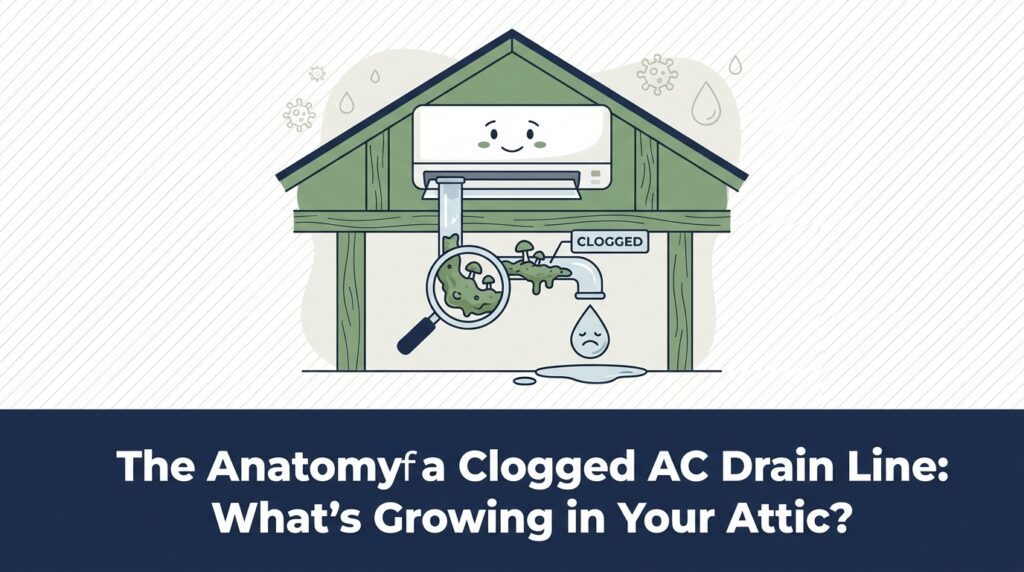
The Hidden Ecosystem Inside Your HVAC Condensate Pan
Your air conditioner is working overtime to keep your home cool, but suddenly you notice a water stain spreading across your ceiling, or your system shuts down completely without warning. When you face this frustrating scenario, our team at MLD Services, LLC finds that understanding the anatomy of a clogged AC drain line is the first step to solving the real problem. Most homeowners assume dirt or dust is the primary culprit behind a blocked pipe, but the truth is much more alive. Biological slime rapidly builds up inside the sweltering environment of your attic, choking off the very pipes designed to protect your home from severe water damage.
During a brutal Texas summer, a standard central air conditioner pulls massive amounts of humidity from your indoor air. As the warm air passes over the freezing evaporator coil, moisture condenses into liquid. This process produces between 5 and 20 gallons of condensate water every single day. This creates a constant, flowing river of moisture right above your living space. To truly protect your home, you need to understand the biology behind this slime. That is why our technicians take a diagnostic, education-first approach. We want to explain the “why” behind the clog, not just the “what.” While deep, stubborn blockages require professional HVAC services, learning how this hidden ecosystem operates empowers you to take effective preventative action before the damage is done.
Deconstructing the Slime: Biofilms, Algae, and Zooglea
When our technicians look inside a clogged condensate pan during a local service call, the blockage usually resembles a pale jelly or wet paper towels. While it is common to refer to this simply as “algae,” the reality is a complex biological matrix. This slime is actually a combination of algae, fungi, airborne dust, and a highly adaptable bacterial mass.
The Role of Zooglea: The primary structural component of this slime is a type of bacteria known scientifically as zooglea. These bacteria thrive in aquatic environments and secrete a sticky, gelatinous polymer. This polymer forms a dense biofilm that allows the bacterial mass to anchor itself tightly to the smooth, non-porous walls of your PVC drain pipes. Once the biofilm is established, it becomes incredibly difficult to wash away with just water.
Airborne Contaminants: Even with high-quality air filters, microscopic airborne spores and fine dust particles constantly circulate through your return ducts. When these particles bypass the filter and hit the wet evaporator coil, they wash down into the condensate pan. The sticky zooglea biofilm acts like a net, catching these particles and incorporating them into the mass, making the slime thicker and more robust.
Environmental Guidelines: The EPA’s Indoor Air Quality guidelines warn heavily against the accumulation of biological pollutants in enclosed spaces. Standing water inside an HVAC system is a prime breeding ground for these pollutants. In the extreme environment of 130°F+ attic temperatures, this biological matrix does not just survive; it thrives. The heat accelerates the metabolic rate of the bacteria, allowing the biofilm to expand rapidly and coat the entire inner circumference of the drain line.
Why Extreme Attic Heat Acts as a Biological Incubator
Understanding the sheer speed at which this biological mass grows requires looking at the environment surrounding the equipment. The enclosed attic space traps radiant heat from the sun, acting like an oven for your HVAC unit. This intense heat of the local climate creates the perfect incubator for biological slime, making rapid clogs a frequent regional issue.
The Problem: A pattern we see often is that homeowners find their drain line was completely clear in May, only to experience a catastrophic backup by July. The biological slime grows incredibly fast, overwhelming the drainage system in a matter of weeks and threatening the drywall below.
The Cause: During a long Texas summer, AC units run for 12 or more hours a day to keep up with the cooling demand. This supplies a continuous, never-ending stream of hydration to the condensate pan. Simultaneously, elevated ambient temperatures drastically accelerate the reproduction rate of bacteria and algae. The thermodynamics of the attic create a micro-climate inside the unit. Enzymatic activity within the zooglea bacteria peaks in warm, dark, wet environments. Furthermore, ASHRAE guidelines on condensate management highlight how extreme temperature differentials—such as freezing cold condensate water hitting a sweltering hot drain pan—can cause condensation on the outside of the pipes as well, contributing to the overall moisture load.
The Solution: Disrupting this high-speed biological incubator requires consistent, proactive condensate management. Because you cannot change the temperature of the attic or stop the AC from producing water, you must alter the chemical environment inside the pipe to make it inhospitable to biofilm formation.
The Mechanics of a Clogged Drain Line Backup
In our years of servicing local HVAC units, we are frequently asked: how does a microscopic layer of bacteria turn into a major plumbing emergency? The progression from a clean pipe to a complete system shutdown follows a predictable mechanical path. The anatomy of your AC drainage system includes specific pinch-points designed for air management, but these same points are highly vulnerable to blockages.
- The Catch in the P-Trap: Just like the plumbing under your sink, your AC drain line features a U-shaped bend called a P-trap. This trap holds a small amount of water to prevent hot attic air or sewer gases from being sucked back into the air handler. Because water sits stagnant in this trap between cooling cycles, it is the primary spot where 130°F+ attic temperatures incubate the zooglea bacteria.
- Particulate Accumulation: As the sticky biofilm establishes itself in the trap, it begins catching the dust, pet dander, and airborne particulates that wash off the evaporator coil. The mass solidifies, turning from a soft jelly into a dense, rubbery plug.
- The Slow Drain: The internal diameter of the PVC pipe narrows. Water begins draining much slower than it is being produced. You might notice the exterior exit pipe dripping sluggishly instead of flowing steadily.
- Float Switch Activation: Once the P-trap is completely blocked, the continuous flow of condensate water has nowhere to go. It backs up into the primary drain pan. Most modern systems are equipped with a safety float switch. As the water level rises, it lifts the float, which breaks the electrical circuit and shuts down the entire AC system to prevent an overflow. (This is a key component checked during understanding AC tune-ups and routine maintenance).
- Condensate Pan Overflow: If the float switch is broken, improperly wired, or absent, the water will crest the edge of the primary pan. It spills into the secondary emergency pan, and if that drain is also clogged or overwhelmed, the water eventually overflows directly onto the ceiling drywall, causing severe structural damage.
The Chemistry of Prevention: Why White Vinegar Beats Bleach
When faced with biological growth, many homeowners instinctively reach for household bleach. While bleach is a powerful disinfectant, it is highly destructive when introduced to an HVAC drainage system. To truly protect your equipment, you need to understand the chemical reaction of your preventative treatments. At MLD Services, LLC, we believe in empowering you with the scientific reasoning behind “why” certain treatments work, ensuring you make the safest choice for your home.
The active ingredient in distilled white vinegar is acetic acid (usually at a 5% concentration). Acetic acid safely penetrates and disrupts the cellular walls of the zooglea bacteria. It dissolves the sticky polymer that makes up the biofilm, preventing the mass from anchoring to the PVC. Because vinegar is a mild acid, it passes through the system without damaging the plastic.
Conversely, household bleach relies on sodium hypochlorite, a highly alkaline oxidizer. While it kills bacteria, it also chemically attacks the PVC cement (the glue) holding your drain line fittings together. Over time, bleach causes the glue to become brittle and crack, leading to hidden water leaks inside your walls or attic. Additionally, bleach off-gassing in a confined, heated space creates corrosive fumes that can severely damage the delicate copper or aluminum fins of your evaporator coil.
| Chemical Feature | White Vinegar (Acetic Acid) | Bleach (Sodium Hypochlorite) |
|---|---|---|
| Action on Biofilms | Safely disrupts cellular walls and dissolves sticky polymers. | Kills bacteria but leaves behind a hardened, oxidized mass. |
| Effect on PVC Glue | Completely harmless to PVC pipes and cement fittings. | Degrades and weakens PVC cement, causing future leaks. |
| Fumes and Off-gassing | Mild odor that dissipates quickly; non-toxic. | Hazardous fumes in confined heat; dangerous to inhale. |
| Safety for AC Coils | Safe for proximity to metal HVAC components. | Highly corrosive to copper and aluminum evaporator coils. |
During a relentless Texas summer, you need a treatment you can apply repeatedly without fear of degrading your system. Our team recommends white vinegar as the chemically sound, manufacturer-approved choice for routine condensate maintenance.


Implementing a Safe Preventative Maintenance Routine
Now that you understand the biology of the slime and the chemistry of the solution, you can implement a safe, effective maintenance routine. Preventative care is about consistency. By treating the drain line regularly, you stop the biofilm from ever establishing a foothold, even when 130°F+ attic temperatures are working against you. Here is how our experts suggest administering the vinegar treatment safely, without crossing into territory that requires a licensed professional.
- Locate the access point: Go to your indoor air handler (usually in the attic or a dedicated closet). Look for a PVC pipe extending from the bottom of the unit. You should find a T-shaped fitting with a small, removable cap pointing straight up. This is your cleanout access.
- Measure your treatment: Remove the cap and pour exactly one-quarter cup of distilled white vinegar down the pipe. Do not use apple cider vinegar or cleaning vinegars with added chemicals.
- Maintain a monthly schedule: Pour the vinegar once every 30 days during the heavy cooling season. Consistency is the key to preventing the zooglea mass from regenerating.
- Check the exterior drip: Walk outside to where the PVC pipe exits your home (usually near the outdoor condenser unit). While the AC is running, you should see a steady drip of water. This confirms the line is clear.
- Address minor blockages safely: If the line is completely backed up and the AC has shut off, pouring vinegar will not instantly clear it. Instead, take a wet/dry vacuum to the exterior exit pipe. Create a tight seal with your hand or a rag around the hose and the pipe, and run the vacuum for three minutes to pull the blockage out from the outside.
- Know your limits: If the wet/dry vacuum cannot dislodge the clog, the blockage may be calcified or located deep within the coil casing. At this point, stop your efforts and rely on a professional diagnostic to prevent damaging the internal components.
Frequently Asked Questions About AC Drain Line Slime
What exactly is the slime in my AC drain line?
The slime in your AC drain line is a biological mass known as zooglea, mixed with algae, fungi, and airborne dust. This sticky matrix forms a protective biofilm that clings to the inside of your PVC pipes. As it grows, it traps dirt and debris, eventually hardening into a solid blockage that stops water flow entirely. During a hot Texas summer, this biological mass grows incredibly fast.
Why does my AC drain line keep clogging in the summer?
Your AC drain line keeps clogging in the summer because high system usage produces massive amounts of condensation, providing a constant water source. Combined with extreme ambient heat, this creates an ideal incubator for biological growth. The warm, wet environment causes bacteria and algae to reproduce at an accelerated rate, overwhelming the pipe much faster than in cooler months.
Does vinegar really clean AC drain lines?
Yes, the acetic acid in white vinegar safely breaks down bacterial biofilms without damaging your PVC pipes or the glue that holds them together. Pouring a small amount into the access line regularly disrupts the cellular structure of the slime. This prevents the zooglea mass from anchoring to the pipe walls and causing a sudden backup.
Can a clogged AC drain line cause property damage?
Yes, a clogged AC drain line can cause severe property damage if the condensate pan overflows. The backed-up water can leak directly through your ceiling, ruin drywall, and permanently damage your attic insulation. Furthermore, standing water inside the home promotes indoor mold growth, which can impact your indoor air quality and require costly remediation.
Is it safe to pour bleach down my AC condensate line?
No, it is not safe to pour bleach down your AC condensate line because bleach is a highly corrosive oxidizer. Over time, sodium hypochlorite degrades the PVC cement holding the pipe fittings together, leading to cracks and leaks inside your walls. Additionally, bleach off-gassing in a hot, enclosed space can corrode the sensitive metal components of your evaporator coil.
Take Control of Your HVAC System’s Health
Understanding the biological and chemical mechanics of your AC drain line empowers you to protect your home from sudden, unexpected water damage. By sticking to a routine white vinegar treatment, you can safely combat rapid slime growth, even when 130°F+ attic temperatures try to turn your HVAC unit into a biological incubator. You now know the science behind the slime, the dangers of using bleach, and the safest, most effective way to maintain your condensate system.
However, routine maintenance can only do so much if a severe blockage has already calcified deep within the system. If you suspect a deep clog that a vacuum cannot clear, or if your system’s float switch keeps tripping repeatedly, do not wait for the primary pan to overflow. Reach out and contact our AC maintenance team at MLD Services, LLC today. We will thoroughly inspect your system’s drainage setup, clear out the hidden ecosystem, and ensure your home stays cool, dry, and protected all season long.
Need HVAC Service?
Contact the experts at MLD Services.
Call us at 512-528-4258!